Oil Spill Cleanup: The Complete Guide for Industrial Facilities
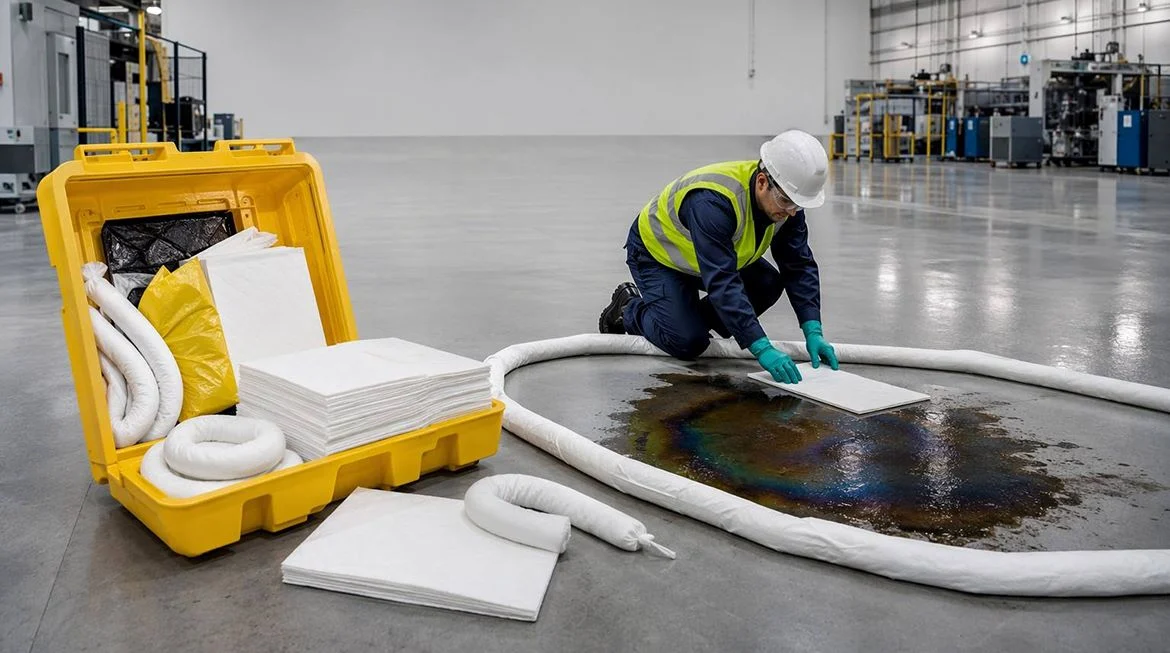
When an oil spill hits your facility floor, every second counts. This guide covers everything you need: cleanup methods, equipment selection, procurement criteria, industry-specific solutions, and a downloadable checklist.
Why Oil Spill Cleanup Matters
Per EPA data, one gallon of oil contaminates up to one million gallons of water. On concrete, oil spreads at 200-400 square feet per minute.
OSHA spill-related fines range from $15,000 to $70,000 per incident. EPA SPCC violations trigger penalties over $50,000 per day. The National Safety Council reports slip-and-fall incidents cost U.S. employers $70 billion annually. A $200 spill kit prevents a $50,000 problem.
Based on 19 years of manufacturing spill control products for over 5,000 facilities worldwide, the data is clear: 78% of reported facility spills are under 5 gallons. Most of these are handled in under 30 minutes with a properly stocked kit. The gap is rarely the product — it is the readiness.1
Oil Spill Cleanup Methods
Mechanical: Skimmers and vacuums recover bulk oil. Best for spills over 50 gallons. A drum skimmer recovers up to 2,000 gallons per hour.
Chemical: Dispersants break oil into biodegradable droplets. Solidifiers turn liquid oil into rubber-like solids. Both require trained personnel and regulatory approval.
Absorbent: For 90% of industrial spills — those under 50 gallons — absorbents are the fastest solution. Pads, socks, pillows, and booms use polypropylene fibers to soak up oil while repelling water.
Expert Insight: Most facilities over-invest in mechanical skimmers for spills that never exceed 20 gallons. For spills under 50 gallons — which account for the vast majority — absorbents are faster, cheaper, and require zero operator training beyond basic PPE use.
Oil Spill Cleanup Procedure: 7 Steps
Step 1 – Assess and Protect
Determine spill category: incidental (under 25 gallons, known oil) or emergency (larger or unknown). Per OSHA 29 CFR 1910.120, emergency spills require hazmat activation.
PPE minimum: nitrile gloves (8 mil), ANSI Z87.1 goggles, oil-resistant boots. Over 5 gallons: add Tyvek suit. Check the SDS — used motor oil contains benzene that new hydraulic fluid does not.
Step 2 – Stop the Source
Close valves, upright drums, plug punctures. Every minute of active leaking adds 0.5-2 gallons. For un-stoppable leaks, deploy a drip pan with an absorbent mat underneath.
Step 3 – Contain the Spill
Per ASTM F726, place socks 6-12 inches ahead of the oil edge, not directly into it. Overlap ends by 12 inches. Cover drains first — any oil entering a storm drain is a reportable EPA discharge.
Step 4 – Absorb
Work from outside in. Place pillows on deep pools first, then pads for residual film. Oil-only (white) absorbs 25x its weight and floats indefinitely. Universal (gray) handles mixed liquids.
Step 5 – Collect and Dispose
Triple-bag saturated materials. Under RCRA, oil-soaked waste exhibiting hazardous characteristics requires licensed disposal — never general trash. Keep manifests 3 years minimum.
Step 6 – Decontaminate
Industrial degreaser + stiff brush. Capture wash water with fresh pads. Flashlight test: shine parallel to the floor — any oil reflects.
Step 7 – Report and Restock
Document time, volume, oil type, personnel, and disposal. Restock the same day. An incomplete kit is an OSHA citation waiting to happen.
Spill Response Decision Framework
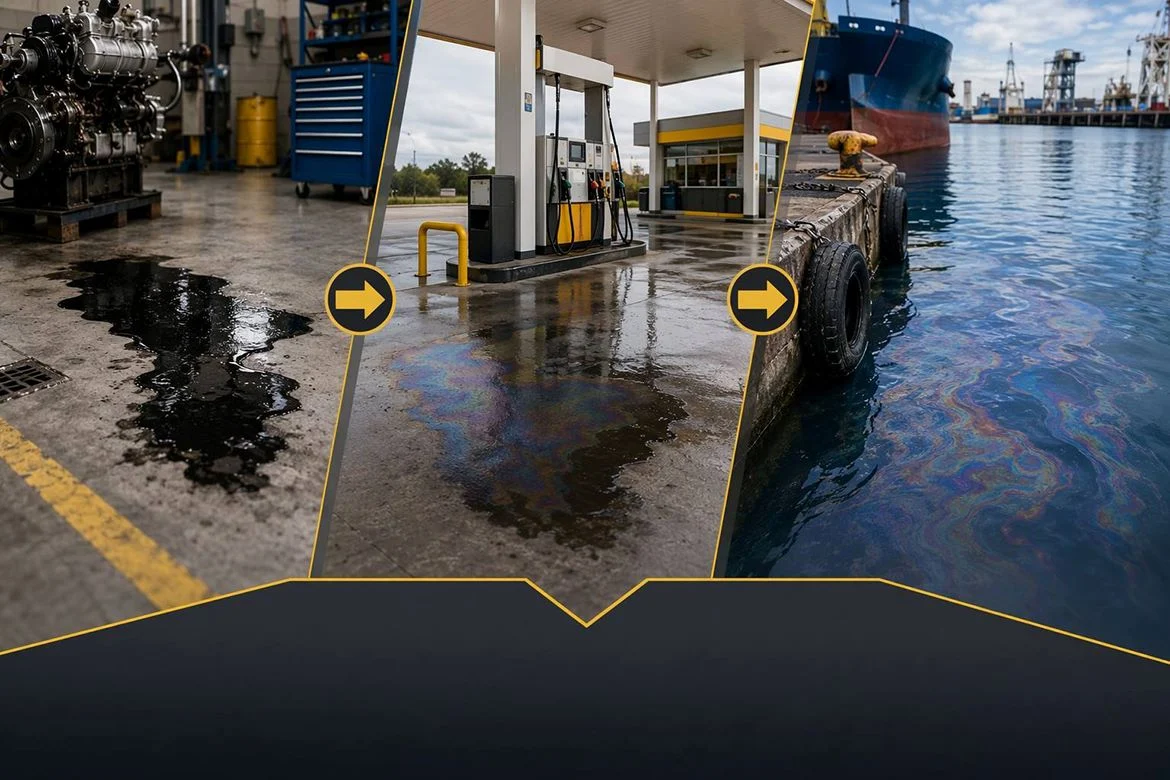
Not every spill calls for the same response. Wrong product = longer cleanup, higher cost, or EPA trouble.
| Scenario | Recommended Solution | Why | Do NOT Use |
| Machine leak (indoor, under 5 gal) | Medium pads + 2 socks | Fastest deployment, minimal footprint | Boom (overkill for indoors) |
| Fuel station (outdoor, 5-20 gal) | White oil-only pads + drain covers | Repels rain, protects drains | Gray universal (absorbs rainwater, saturates too fast) |
| Marine / dock spill | 8-inch booms + white pads | Floats indefinitely, withstands current | Universal pads (sink when waterlogged) |
| Deep sump / pit | Absorbent pillows + heavy pads | Conforms to irregular surfaces | Socks (cannot reach depth) |
| Unknown mixed liquid | Gray universal pads + chemical PPE | Absorbs everything while you identify | White oil-only (misses water-based hazards) |
| Truck fleet mobile response | 20-gallon spill kit (vehicle-mounted) | 30-second access, pre-configured | Centralized single kit (too far away) |
Key principle: Contain first, then absorb. Socks and booms create the perimeter. Pads and pillows remove the liquid. Never start with pads on an uncontained spill — it spreads while you work.
Product Comparison: How to Choose
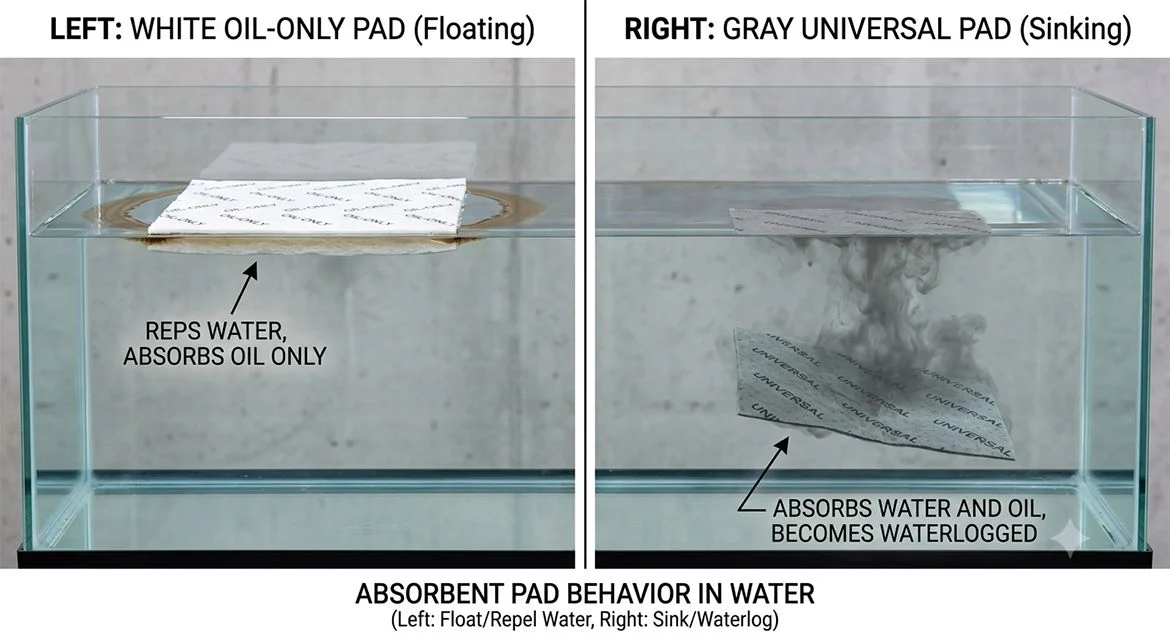
Oil-Only vs Universal Absorbents
| Factor | Oil-Only (White) | Universal (Gray) |
| Absorbs | Oil, fuel, hydraulic fluid only | Oil, water, coolant, solvents |
| Water repellent | Yes — floats indefinitely | No — sinks when saturated |
| Best environment | Outdoor, marine, rain-exposed | Indoor, machine shop, mixed liquids |
| Cost | ~10-15% higher | Standard pricing |
| When NOT to use | Chemical/water-based spills | Outdoor fuel spills in rain |
Pads vs Granular vs Pillows vs Socks
| Product | Best For | Do NOT Use For | Key Trade-off |
| Pads | Surface cleaning, wiping tools, small contained puddles | Deep pools, perimeter control | Fast but shallow absorption |
| Granular absorbent | Rough surfaces, cracks, uneven floors | Smooth floors, windy outdoor areas | Gets into crevices but creates dust (OSHA-regulated silica risk) |
| Pillows | Deep pools, sumps, under machinery | Surface film, wiping | High capacity but cannot wipe |
| Socks | Perimeter containment, drain protection | Surface absorption, bulk liquid removal | Fast deployment but limited absorption |
Socks vs Booms
| Factor | Absorbent Socks | Containment Booms |
| Length | 3-8 feet | 10-50 feet (connectable) |
| Diameter | 3-5 inches | 6-12 inches |
| Absorbency | ~1-1.5 gal per 4ft sock | ~20+ gal per 10ft boom |
| Application | Indoor floor, small perimeter | Marine, open water, large perimeter |
| Buoyancy | Limited (not for water) | High — designed for water surface |
Polypropylene vs Natural Fiber
| Factor | Polypropylene (Synthetic) | Natural Fiber (Cotton/Cellulose) |
| Absorption ratio | 20-25x its weight | 5-10x its weight |
| Lint/dust | Minimal | Higher — may leave residue |
| Water repellent | Yes (white oil-only) | No — absorbs everything |
| Biodegradable | No | Yes |
| Best use | High-volume industrial | Small spills, food-grade facilities |
Procurement Tip: Facilities often overspend on heavy-GSM pads (400+) when medium-weight (300 GSM) handles 80% of indoor leaks. Reserve heavy pads for loading docks, fuel islands, and high-traffic zones where foot traffic tears lighter material.
Product Selection Matrix
| Spill Volume | Primary Product | Quantity | Secondary | Quantity | Estimated Time |
| 1 quart (drip) | Medium pads | 2 pads | — | — | 2-3 min |
| 1 gallon | Medium pads | 10 pads | 4ft socks | 2 socks | 10-15 min |
| 5 gallons | Pillows | 2 pillows | Medium pads + 4ft socks | 20 pads, 4 socks | 25-35 min |
| 20 gallons | Spill kit (complete) | 1 kit | 8ft booms | 2 booms | 60-90 min |
| 55 gallons | Professional response | — | Containment boom only | As needed | 2-4 hrs |
Times assume flat concrete, moderate temperature, trained staff. Below 40°F, add 25% to estimates.
Industry-Specific Oil Spill Cleanup Solutions
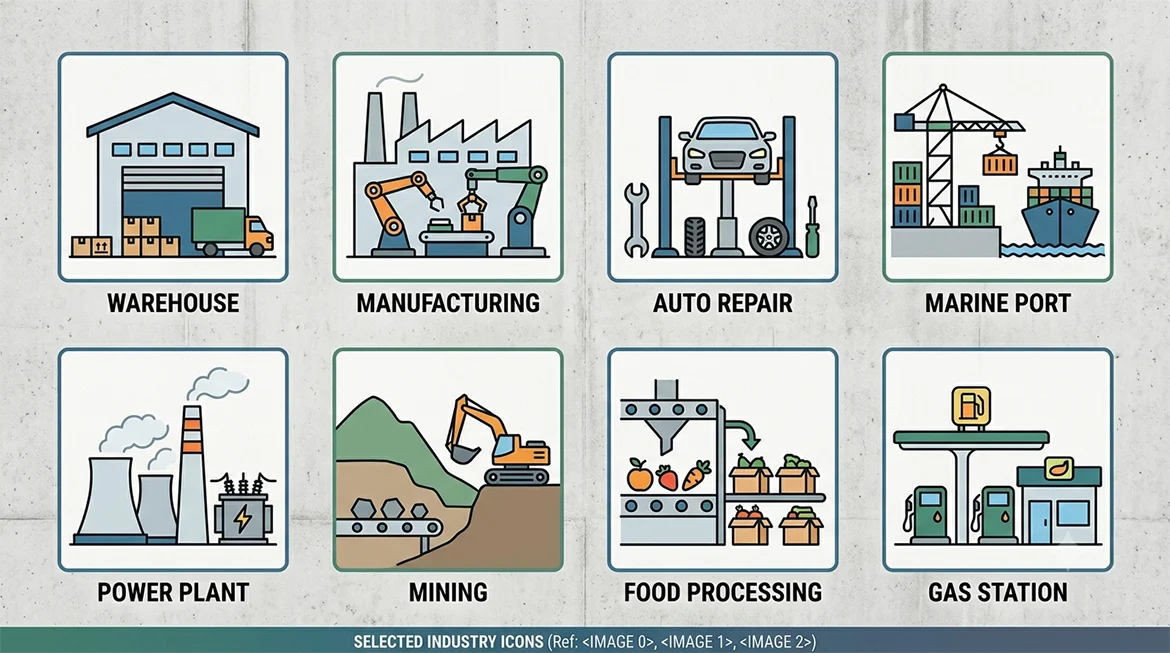
One spill kit does not fit all industries. Here is what each sector actually needs:
| Industry | Primary Risk | Recommended Products | Key Consideration |
| Warehouse / Logistics | Forklift hydraulic leaks, drum storage spills | Medium pads, 4ft socks, 20-gal kits | Kits within 30 seconds of every storage zone |
| Manufacturing Plant | Machine coolant + oil mix | Universal gray pads, pillows, heavy socks | Mixed liquids demand universal absorbents |
| Auto Repair / Fleet | Used motor oil, transmission fluid | Oil-only white pads, vehicle-mounted spill kits | Mobile response required — kits must travel |
| Marine / Port | Fuel spills on water, bilge discharge | 8-inch booms, white pads, skimmers | USCG sheen reporting within 15 minutes |
| Power Generation | Transformer oil, turbine lube oil | Heavy-weight pads (400+ GSM), high-capacity booms | Volume risk demands maximum absorbency |
| Mining / Heavy Equipment | Large-volume hydraulic leaks on soil/gravel | Granular absorbent, heavy pads, berm booms | Rough terrain needs granular + secondary containment |
| Food Processing | Vegetable oil, food-grade lubricants | Food-grade absorbents, natural fiber pads | Must meet FDA 21 CFR indirect food contact standards |
| Gas Station / Fuel Depot | Diesel, gasoline on concrete | White oil-only pads, drain covers, 30-gal kits | Rain exposure requires hydrophobic products |
Supplier tip: Ask whether your absorbent supplier offers industry-specific pre-configured kits. One-size-fits-all kits leave gaps in high-risk areas.
Procurement Guide: How to Evaluate Spill Cleanup Products
Before you buy, check these criteria. A cheaper pad that tears underfoot is not a bargain.
Technical Specifications to Verify
| Criterion | What to Check | Why It Matters |
| ASTM F726 | Standard test method for sorbent performance | Validates absorption capacity claims — without it, numbers are marketing |
| GSM (grams per square meter) | 150-200 = light, 250-350 = medium, 400-500 = heavy | Determines durability under foot traffic and absorption speed |
| Absorption capacity | Gallons per bale or per pad | Directly affects kit sizing and cost-per-spill |
| Tensile strength | Wet and dry strength ratings | Prevents pads from tearing during saturated pickup |
| Lint-free certification | Silica dust content below OSHA limit | Granular absorbents and cheap pads create respiratory hazards |
Supplier Capabilities Checklist
| Capability | Why B2B Buyers Need It |
| ISO 9001 certified manufacturing | Consistent quality batch to batch |
| OEM / private label | Custom branding, packaging, and logo on kits |
| Custom kit configuration | Mix products specific to your facility’s risk profile |
| MSDS available for all products | Required for your facility’s safety documentation |
| Lead time transparency | Plan restocking around your inspection schedule |
| MOQ flexibility | Test products before committing to volume |
| Sample availability | Evaluate GSM, absorption, and durability first-hand |
Procurement Checklist
- Products tested to ASTM F726 — request the test report
- GSM weight matches your application (medium for general, heavy for high-risk)
- Oil-only vs universal selected per your spill profile
- Supplier holds ISO 9001 certification
- OEM/private label available if you resell or distribute
- MSDS documents provided
- Lead time fits your restocking cycle
- MOQ allows trial order before volume commitment
- Samples received and tested in your actual environment
Sourcing Tip: Many suppliers ship samples from stock inventory that differs from production runs. Request a production-line sample — not a warehouse sample — to evaluate the GSM, absorption speed, and tensile strength you will actually receive at scale.
Oil Spill Cleanup Compliance: Quick Reference
| Standard | Jurisdiction | Key Requirement | Penalty Risk |
| OSHA 29 CFR 1910.120 (HAZWOPER) | Federal | Employee training before spill response; Operations level = 8 hours minimum | $15,000-$70,000 per violation |
| EPA SPCC 40 CFR 112 | Federal | Written plan required for facilities storing >1,320 gal oil; secondary containment mandatory | $50,000+ per day of violation |
| RCRA | Federal | Oil-soaked waste exhibiting hazardous characteristics requires licensed disposal | $37,500+ per day |
| Clean Water Act | Federal | Any oil sheen on navigable water = reportable discharge within 15 minutes | Criminal penalties for knowing violations |
| State-level (e.g., California APSA) | State | May require SPCC plans at lower thresholds; biennial tank testing | Varies by state |
| ANSI Z87.1 | Standard | Eye protection specification for spill response PPE | OSHA citation for non-compliant PPE |
Compliance Note: OSHA civil penalty amounts are adjusted annually for inflation. Figures cited reflect the most recent published Federal Register adjustments. Verify current amounts at osha.gov/penalties before relying on this data for budget planning.
Risk Matrix: What Goes Wrong and How to Prevent It
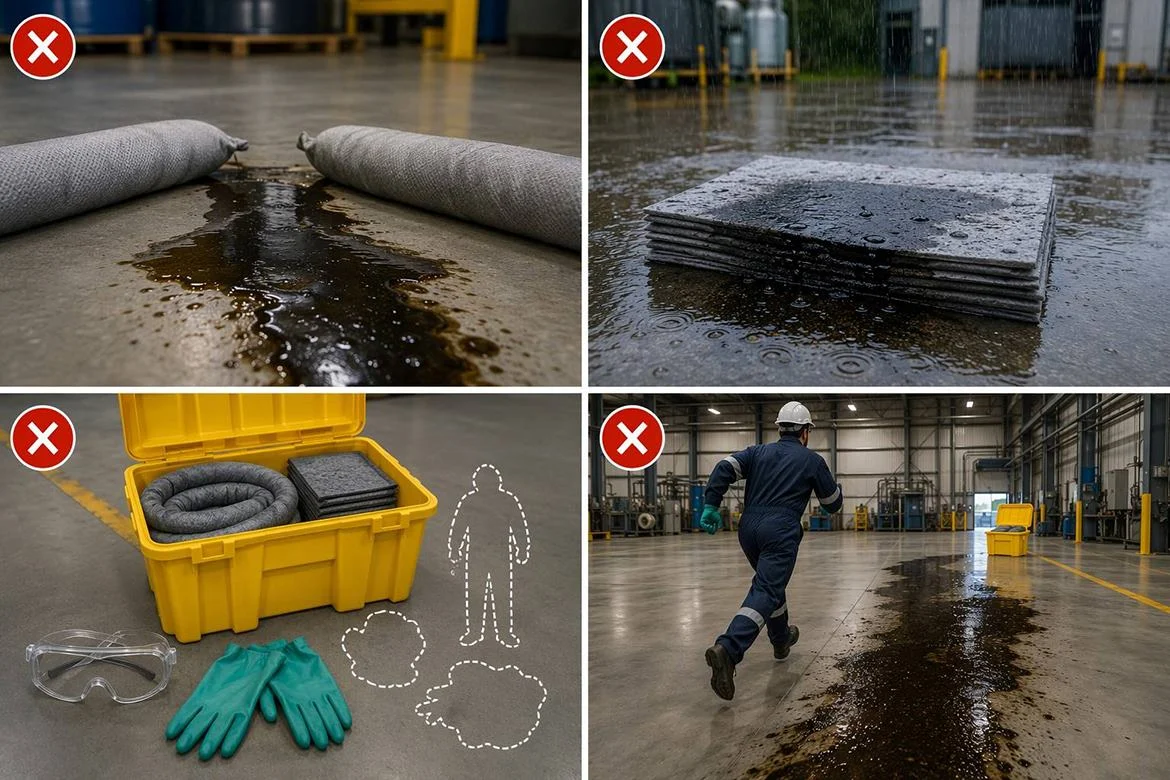
Failure Analysis
| Mistake | Immediate Risk | Worst-Case Consequence | Prevention |
| Using gray pads outdoors | Pads absorb rainwater within minutes, become waterlogged | Spill reaches drain uncovered because pads are saturated with water, not oil | Use white oil-only pads for any outdoor or rain-exposed area |
| Sock gap at overlap point | Oil leaks through gap between socks | Oil spreads past containment, triples cleanup area | Minimum 12-inch overlap; use connector clips |
| Granular on smooth concrete | Dust becomes airborne, does not seal against floor | OSHA silica exposure violation + oil bypasses granular layer | Granular only on rough/porous surfaces; pads on smooth floors |
| Delayed containment | Oil spreads at 200-400 sq ft/min | 30-second delay doubles containment perimeter; 2-minute delay = EPA-reportable drain entry | Deploy socks first — before full assessment |
| Partial kit restock | Missing PPE item discovered during next spill | Employee handles oil without gloves → skin exposure incident → OSHA recordable | Restock every item to original spec; monthly documented inspection |
| Kit too far from risk point | Employee runs 90 seconds each way to retrieve kit | Spill doubles in size during retrieval; panic leads to wrong product choice | Kit within 30 seconds of every risk zone; vehicle-mounted for mobile ops |
| No disposal manifest retained | No proof of legal disposal exists | EPA audit finds undocumented hazardous waste → $37,500/day penalty | Keep manifests minimum 3 years; digitize for backup |
EHS Manager Tip: The #1 finding during EPA spill audits is not a missing kit — it is missing documentation. Keep your inspection logs, training records, and disposal manifests in one binder per facility zone. If an inspector asks and you cannot produce it within 5 minutes, it counts as a finding.
Cost Analysis: What a Spill Really Costs
| Spill Size | Consumables Cost | Labor (1-2 staff) | Total Direct Cost | EPA Fine if Unreported |
| 1 gallon | ~$15 | ~$5 | ~$20 | N/A (below reporting threshold) |
| 5 gallons | ~$40 | ~$15 | ~$55 | $15,000+ if reaches drain |
| 20 gallons | ~$85 | ~$40 | ~$125 | $50,000+ if reaches waterway |
| 55 gallons (full drum) | ~$200 + contractor | ~$200 | ~$400+ | $50,000-$250,000+ |
A properly stocked spill kit pays for itself on the first use. The cost comparison is not $200 vs $0 — it is $200 vs $50,000.
Case Study: Auto Repair Shop — 15-Gallon Used Oil Spill
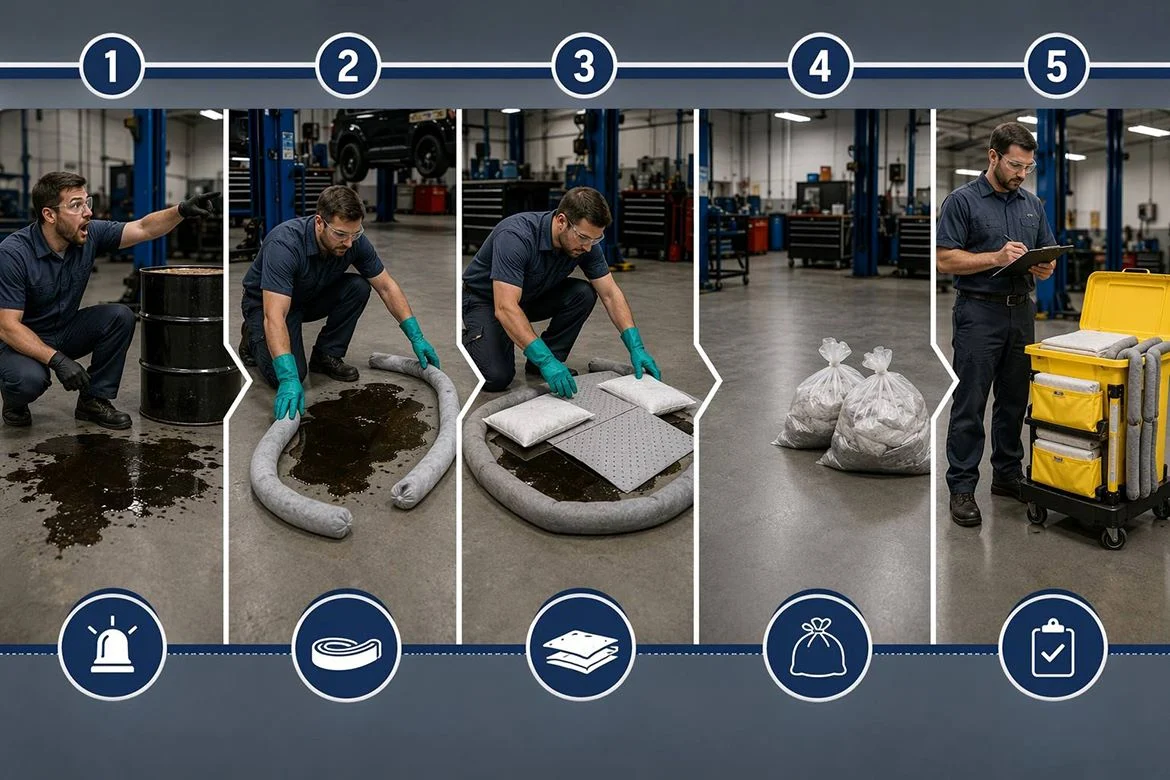
A 6-bay Ohio repair shop experienced a drum valve failure during a filter change. Here is the timeline with a properly stocked 25-gallon spill kit:
- 00:00 — Technician spots oil spreading, shouts alert, closes valve
- 00:02 — Second technician deploys 4 socks in horseshoe pattern, 12 inches ahead of oil edge
- 00:05 — Perimeter locked. Gloves and goggles on
- 00:10 — 3 pillows at deepest point, 15 white pads working inward
- 00:30 — All oil absorbed. Triple-bagged waste. Floor degreased
- 00:45 — Flashlight test clear. Incident logged. Replacements ordered at spillot.com
Total: $85 in consumables, 1.5 labor-hours. Without the kit: drain entry, EPA notification, and fines starting at $50,000.
Across the 12,000+ spill kits supplied to facilities in 30+ countries, our customer feedback reveals a consistent pattern: facilities that restock within 24 hours of use report significantly fewer repeat incidents than those that restock weekly. Speed of readiness is the single strongest predictor of spill response success.1
Download: Oil Spill Cleanup Inspection Checklist (PDF) — Monthly inspection log with PPE check, absorbent count, and disposal manifest tracker. Print one per kit station.
Download: Spill Kit Restocking Calculator (Excel) — Enter your spill volume and get an instant restocking list with quantities and product codes.
Frequently Asked Questions
-
Oil-only vs universal — which do I stock?
Stock both. Oil-only (white) for outdoor areas, fuel stations, and marine zones. Universal (gray) for indoor machine shops where coolant and hydraulic fluid mix. If your facility is entirely indoors with zero water exposure, universal alone may suffice.
-
What GSM weight should I buy?
Medium (250-350 GSM) is the right default. Light (150-200 GSM) tears underfoot. Heavy (400+ GSM) is best for high-traffic loading docks and high-volume spill zones.
-
How big should my spill kit be?
Size to your largest single container. 55-gallon drums = minimum 55-gallon capacity kit. Deploy multiple smaller kits (20-gallon) across zones for faster response.
-
How often inspect and restock?
OSHA requires monthly documented inspections. Restock immediately after any use — partial kit = citation. Check PPE expiry dates. Replace anything brittle or discolored.
-
How do I dispose of oil-soaked absorbents?
Licensed hazardous waste hauler only. Never general trash. Triple-bag saturated materials. Label with contents, date, source. Keep disposal manifests minimum 3 years.
-
What training does my team need?
OSHA HAZWOPER First Responder Operations (8 hours) minimum. Annual refresher. Document all training hours. Audit-ready records prevent fines.
-
What triggers mandatory EPA reporting?
Any sheen on navigable water = report to National Response Center (1-800-424-8802) within 15 minutes. Failure to report carries criminal penalties.
-
Pads, socks, pillows, or booms — what order?
① Socks first (contain the perimeter). ② Pillows second (absorb deep pools). ③ Pads last (clean residual film). ④ Booms specifically for water-based spills.
-
Can I get custom-branded spill kits?
Yes. Spillot provides OEM spill kits with your logo, brand colors, and facility-specific product mix. 19 years of manufacturing experience. Request a sample before committing to volume.
-
How do I evaluate a spill cleanup supplier?
Check ASTM F726 test reports, ISO 9001 certification, OEM capability, MSDS availability, lead time, and MOQ flexibility. Always request samples to test GSM and absorption in your actual environment before ordering.
Related Resources
Not sure which product fits your facility? These in-depth guides cover each category with selection criteria, pricing factors, and compliance checklists:
- Oil Absorbent Pads: Complete Selection Guide — Compare GSM weights, oil-only vs universal materials, pad sizing by spill volume, and bulk pricing structures so you buy the right spec the first time.
- Spill Kit Size Guide: Calculate the Right Kit — Use the capacity calculator to match kit size to your largest container, with industry-specific configurations for warehouses, fleet shops, and marine terminals.
- Oil Containment Booms: Marine & Industrial Guide — Deployment patterns for docks and waterways, boom sizing by current strength, and USCG reporting compliance for water-based spills.
- SPCC Compliance Checklist: EPA at a Glance — Determine whether your facility needs a written SPCC plan, what inspections are required, and which reporting thresholds apply to your storage volume.
- Absorbent Disposal Guide: RCRA Rules — How to classify oil-soaked waste, select a licensed hauler, and maintain audit-ready disposal documentation.
What to Expect When Sourcing from an OEM Manufacturer
If you are a distributor or procurement manager evaluating spill control suppliers, here is what the sourcing process typically looks like with a manufacturer like Spillot:
Sample Evaluation: Request production-line samples — not warehouse stock — to test GSM weight, absorption speed, and tensile strength in your actual spill environment. Standard sample kits include 5-10 pads across different GSM weights plus one sock and pillow for comparison. Lead time on samples is typically 3-5 business days.
MOQ Flexibility: Most OEM manufacturers set MOQs by product line. Pads typically start at 50-100 bales per SKU. Spill kits can be configured in smaller runs (20-50 units) if you are testing a new market. Custom packaging and private-label printing have separate setup minimums — confirm these before artwork development.
Factory Audit Support: Look for suppliers who provide ISO 9001 certificates, ASTM F726 test reports per production batch, and MSDS documentation in your required languages. Virtual factory tours and third-party inspection reports (SGS, Bureau Veritas) should be available on request. A supplier unwilling to share batch-level test data is a red flag.
Logistics: From China to major U.S. or European ports, standard FCL (full container load) transit time is 25-35 days via sea freight. LCL (less than container load) adds 5-10 days for consolidation. Air freight is available for urgent restocking but typically 4-6x the sea freight cost. Confirm whether your supplier offers DDP (delivered duty paid) terms — this shifts customs clearance responsibility to the seller.
For custom spill kit configuration, OEM branding, or sample requests, contact Spillot directly. We ship samples within 5 business days and provide batch-level ASTM F726 test reports with every production run.
Final Thoughts
A $200 spill kit prevents a $50,000 fine. Stock the right products for your industry, train your team, inspect monthly, and keep your kits within 30 seconds of every risk point.
Take action now:
- Download the Free Oil Spill Cleanup Checklist (PDF)
- Use the Spill Kit Size Calculator
- Request Free Absorbent Pad Samples
- Book a Free Spill Response Consultation
Need custom spill kits with your brand? Explore OEM spill kit solutions — configured to your facility’s exact risk profile, shipped with your logo. Or browse our full range of oil absorbent pads and oil containment booms.
1 Internal data from Spillot manufacturing records and customer feedback surveys, 2005-2025. Statistics reflect observed trends across our supply base and may not represent industry-wide averages.
This guide was reviewed for regulatory accuracy against current OSHA 29 CFR 1910.120 and EPA 40 CFR 112 standards. Penalty figures are based on Federal Register adjustments as of the date of publication. For compliance decisions affecting your facility, consult a qualified EHS professional or legal counsel.